By TPS People

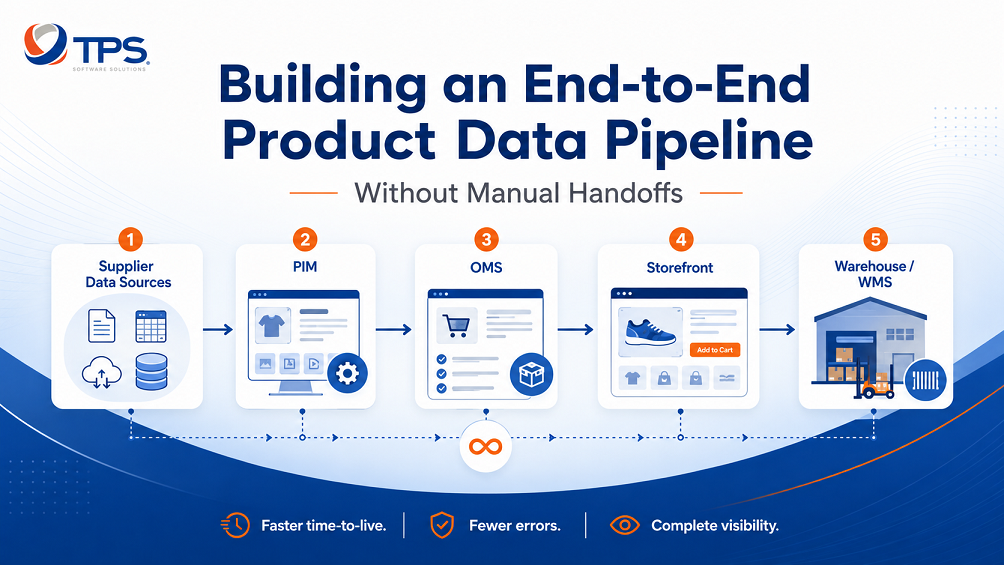
Building an End-to-End Product Data Pipeline Without Manual Handoffs

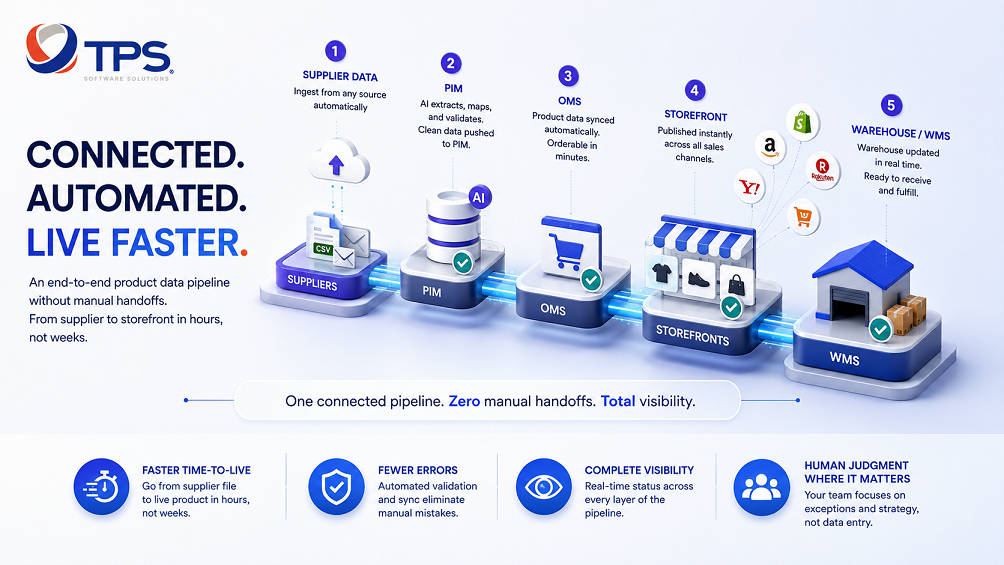
Every e-commerce business has a product data pipeline — even if they’ve never called it that. It starts when a supplier sends product information and ends when that product is live, priced, discoverable, and fulfillable. Everything in between is the pipeline.

Why Handoffs Are Where Pipelines Break

When a human has to take data from one system and put it into another, several things happen:

  • Delay accumulates — the handoff waits until someone has bandwidth
  • Errors compound — each manual handoff introduces its own error rate
  • Context gets lost — units, conventions, and relationships between attributes get stripped away
  • Visibility disappears — tracking status across manual handoffs is nearly impossible

The Five Integration Layers

Supplier data sources iconLayer 1 · Supplier Data Sources

Supplier data is ingested directly by the platform — via file upload, email attachment processing, API connection, or automated scraping. No human needs to receive and route the file. Ingestion triggers automatically. Suppliers don’t change how they work.

PIM icon

Layer 2 · PIM

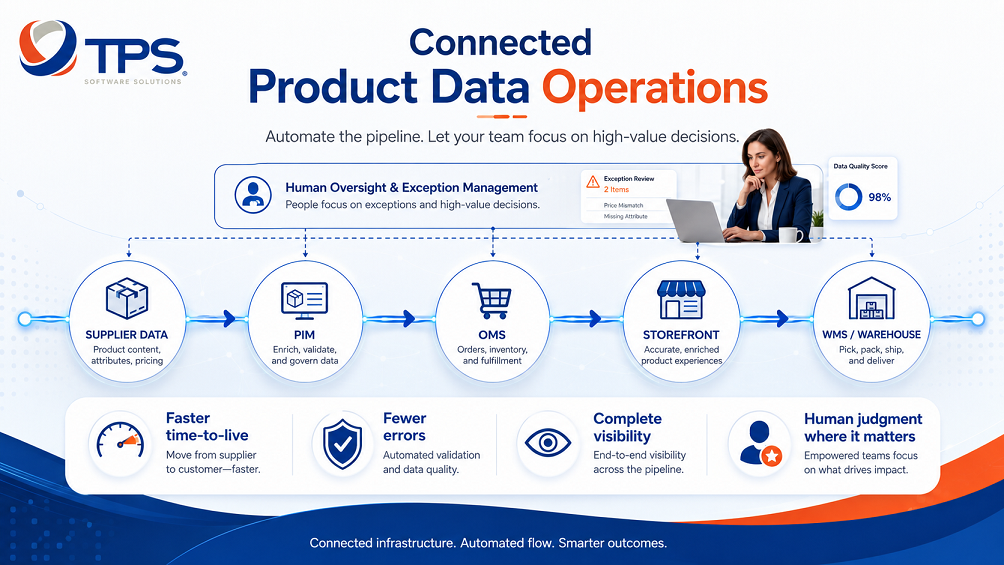
AI extracts, maps, and validates data against your PIM schema automatically. Clean, structured records pushed directly via API. Human reviewers address flagged exceptions — typically less than 5% of records. Compatible with Akeneo, Salsify, Plytix, Contentserv, and custom PIM via REST API

OMS icon

Layer 3 · OMS

When a new product record is created or updated in PIM, the change propagates to OMS automatically via webhook or real-time API sync. New products are orderable within minutes of being approved.

Storefront icon

Layer 4 · Storefront

Storefront publication triggered automatically when a product record passes validation in PIM, with configurable approval workflows. Compatible with Shopify, Magento, WooCommerce, custom storefronts, and Japanese platforms (Rakuten, Yahoo! Shopping, Amazon Japan)

Warehouse / WMS icon

Layer 5 · Warehouse / WMS

Product records are pushed to WMS simultaneously with storefront publication. Warehouse staff can receive, locate, and fulfill new products from day one.
End-to-End Timeline Example

TimeWhat Happens
T+0:00Supplier sends product files
T+1:00Extraction complete. 2,000 records mapped. 47 flagged (2.4%).
T+1:30Human reviewer addresses 47 flagged records. Images processed.
T+2:00Reviewer approves batch. Push to PIM. OMS sync triggers.
T+2:30Storefront live. WMS updated. Visual Search index updated.
T+3:00Pricing team reviews intelligence report. Sets launch prices.

Conclusion

A product data pipeline without manual handoffs is a practical reality for e-commerce businesses that have invested in connected infrastructure. The payoff: faster time-to-live, fewer errors, complete visibility, and an ops team that spends its time on work that actually requires human judgment.

Want to see what a connected pipeline looks like for your specific systems?
👉 Book a 30-minute session: Contact – TPS Software: Trust Software Development & Consulting

Facebook
Twitter
LinkedIn