Ask any e-commerce operations manager what slows down their growth, and you’ll hear the usual suspects: traffic, conversion rates, pricing strategy, logistics. Rarely do they mention the product catalog.
But after working with e-commerce businesses across Vietnam, Japan, Thailand, and North America for over a decade — managing everything from 500 to 250,000 SKUs — we’ve found that catalog operations are quietly one of the biggest growth bottlenecks in the industry.
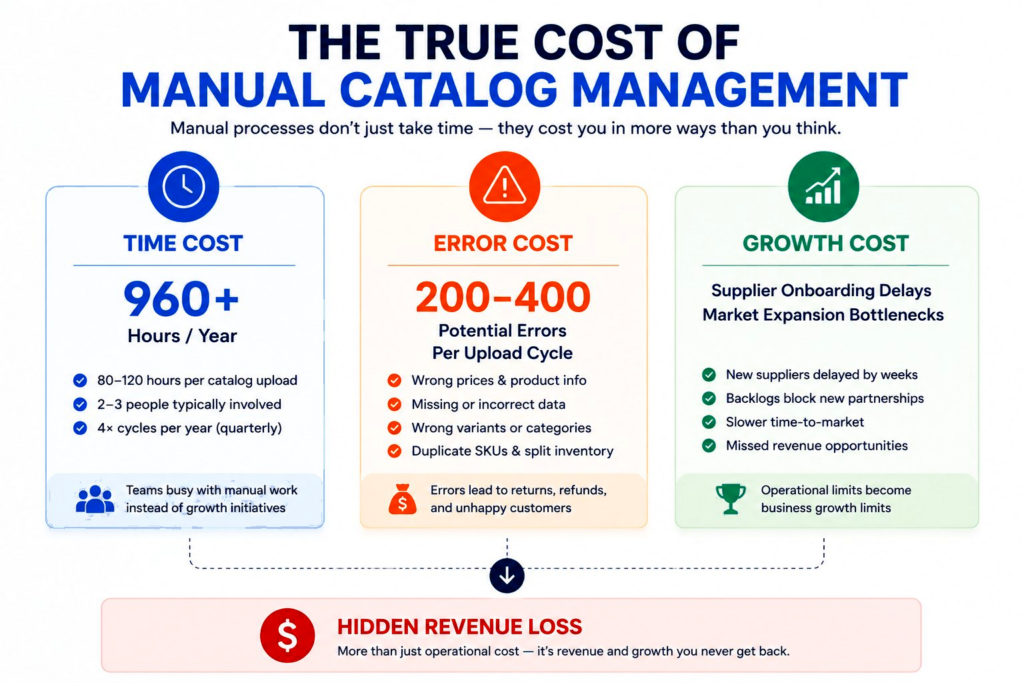
The three hidden cost categories of manual catalog operations
Three Hidden Cost Categories
1. Time cost: the hours no one counts
A mid-sized fashion retailer receives product data from 12 suppliers. Each supplier sends a spreadsheet — but every spreadsheet is formatted differently. Your operations team opens each file, maps it to your internal product schema, cleans the data, uploads it, and checks every SKU manually.
For 2,000 products, this typically takes:
•80–120 hours per catalog upload
•2–3 people typically involved
•4× cycles per year (quarterly)
•960h+ total hours/year at 2,000 SKUs
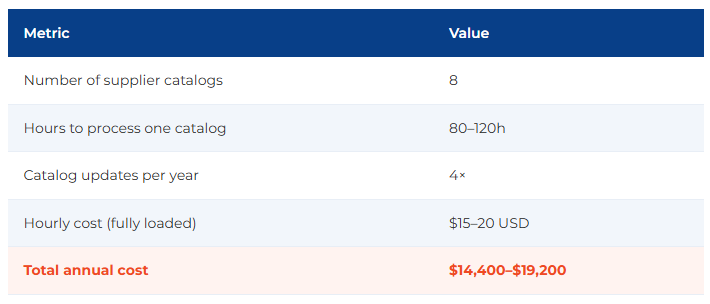
At a fully-loaded salary cost of $15–20/hour, that’s $14,400–$19,200 spent on data entry every year — for just one catalog.
2. Error cost: the risk you can’t see
Manual data entry has a well-documented error rate of 0.5%–1% of data points entered. For a 2,000-SKU catalog with 20 data fields per product, that’s 200–400 potential errors per upload cycle. What do those errors look like?
•Wrong price published: a $120 item listed at $12 due to a decimal error
•Missing product description: customer bounces
•Incorrect variant mapping: customer orders Size M, receives Size L
•Wrong category assignment: product doesn’t appear in search results
•Duplicate SKU creation: inventory system splits stock across two records
3. Growth cost: the ceiling you don’t see
When catalog operations are manual, growth is constrained by team bandwidth. We call this the “catalog ceiling” — the point where the operational cost of adding one more supplier exceeds the perceived benefit.
•Q1 goal: add 3 new supplier catalogs. Reality: team is still processing Q4 updates.
•New brand partnership: on hold for 6 weeks while ops clears backlog
•Expansion to new market: requires rebuilding catalog in new language/format. Deprioritized indefinitely
Calculate Your Own Exposure
What the Alternative Looks Like
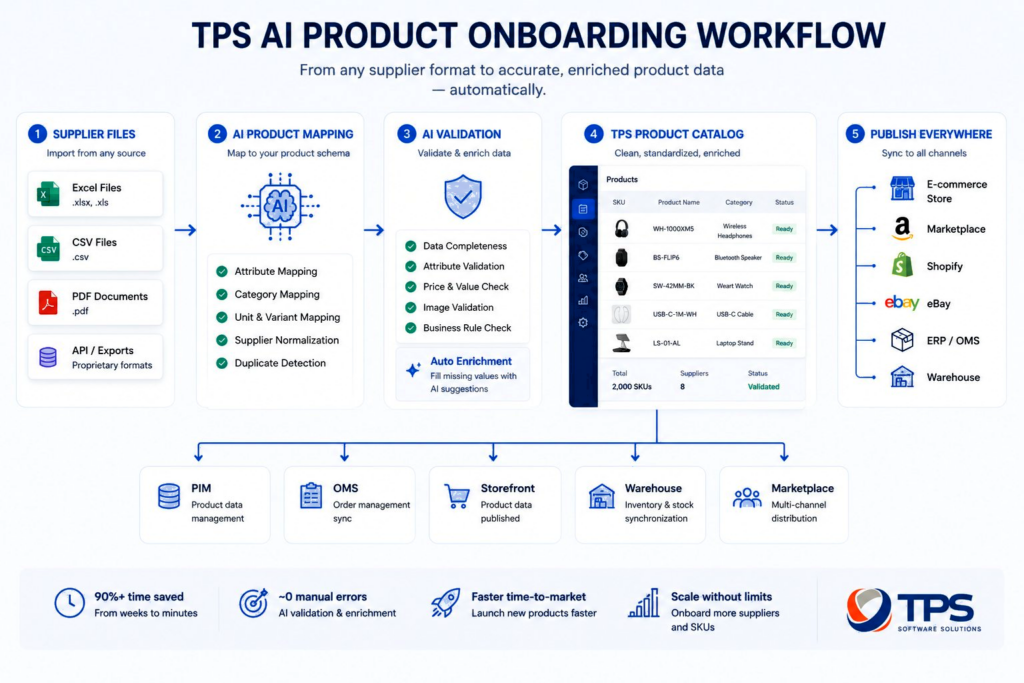
TPS AI Product Onboarding handles this automatically — configured to your business logic, your PIM schema, and your supplier relationships.
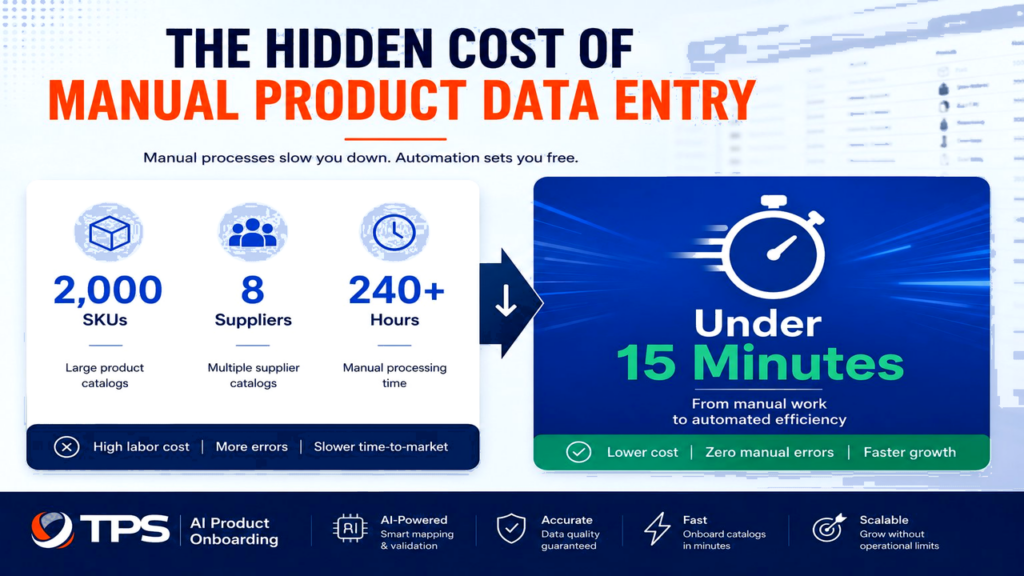
2,000 SKUs from 8 suppliers processed in under 15 minutes
~0 manual errors via AI normalization
Works with any supplier format: PDF, Excel, CSV, proprietary exports
Outputs directly to your PIM, OMS, storefront, and warehouse systems
Ready to see it in action? We demo with your actual supplier data — no slides, no generic walkthrough.



 Book a 30-minute session: Contact – TPS Software: Trust Software Development & Consulting