Japan’s e-commerce market is one of the most attractive expansion opportunities in Asia — a $200B+ market, sophisticated consumers, high average order values, and a growing appetite for cross-border product discovery. It’s also one of the most operationally demanding markets to enter.

The Japanese Supplier Relationship: Context First
In most SEA markets, supplier relationships are transactional and relatively flexible. In Japan, they’re long-term, formal, and built on a foundation of mutual respect and minimal disruption.
The concept of meiwaku — roughly, “causing inconvenience to others” — is a genuine business consideration. Asking a supplier to change their processes, even in a small way, can feel uncomfortable in the context of a relationship maintained the same way for decades.
What Japanese Supplier Data Actually Looks Like

- Modern digital formats (30–40%): Excel, CSV, structured PDFs with Japanese-language headers
- Legacy digital formats (30–40%): Older Excel, proprietary software exports, HTML extracts from legacy systems
- Physical/scanned formats (20–30%): Printed catalogs scanned to PDF, handwritten specification sheets, fax-derived documents
The challenge isn’t that any one format is impossible to process. It’s that you’re managing all of them simultaneously, across 50–100 supplier partners, without the ability to standardize at the source.
How AI Changes the Japan Operations Equation

Format agnosticism
The system processes any format — modern Excel, legacy exports, scanned PDFs, handwritten specifications via OCR. Suppliers don’t change anything.

Japanese language processing
NLP models trained on Japanese product content handle Japanese-language extraction, attribute identification, and data normalization natively — including mixed kanji/kana/romaji documents.

Supplier profile memory
Once the system has processed a supplier’s data once, it remembers their format and conventions. Every subsequent cycle from that supplier is processed faster and more accurately.

Bilingual output
Data is normalized and loaded into PIM in both Japanese and English — ready for domestic Japanese storefronts and international platforms.
Real-World Japan Market Results
| Metric | Value |
|---|---|
| Suppliers | 60 Japanese suppliers (furniture & home goods) |
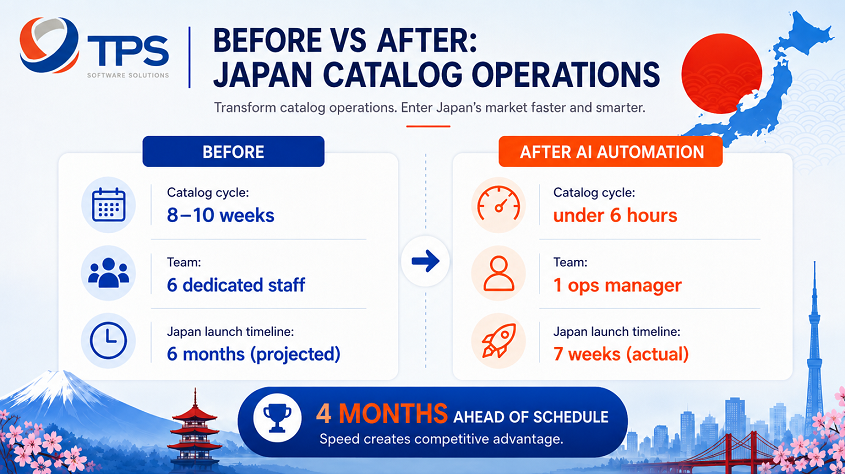
| Catalog cycle — before | 8–10 weeks |
| Catalog cycle — after | Under 6 hours |
| Team required | 1 ops manager (down from 6 dedicated staff) |
| Japan launch — projected | 6 months from supplier contracts |
| Japan launch — actual | 7 weeks — 4 months ahead of schedule |
8–10 weeks became under 6 hours — with 60 Japanese suppliers, and zero changes on their side.
Three Things to Do Before You Start Japan Catalog Operations
- Audit your supplier data landscape before you sign contracts — ask what format they send data in
- Define your bilingual PIM schema early — Japanese naming conventions and sizing standards differ from other markets
- Don’t plan your launch timeline around manual catalog operations — build in 3–4× buffer or invest in automation first
Conclusion
Japan is a high-value, high-complexity market. The catalog operations challenge is real — but solvable, faster than most businesses expect, with the right tooling. The businesses that enter Japan successfully can handle Japanese supplier data at scale — without asking their suppliers to change a thing.
Planning Japan market entry?
Let’s talk about the catalog ops layer.
Our Tokyo office team is available for Japan-specific consultations.
Book a 30-Minute Session →