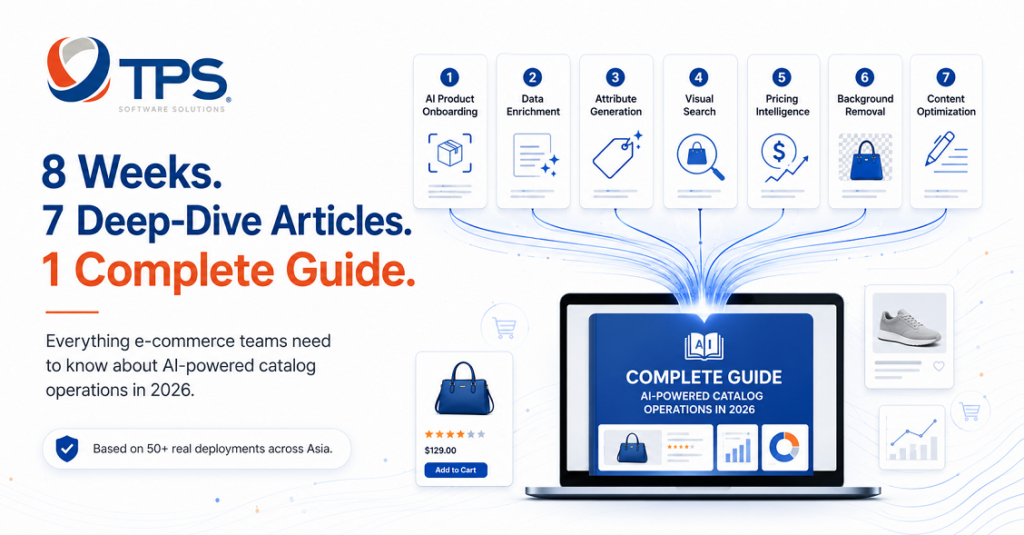
Over the past eight weeks, we’ve published detailed breakdowns of every major operational challenge facing scaling e-commerce businesses — and the AI solutions that are now production-ready to solve them.
This guide connects the dots: what the four operational bottlenecks are, how they relate to each other, and what it looks like when they’re all solved at once.
The Four Bottlenecks
Every e-commerce business that reaches scale hits the same four walls — usually in this order.
Product data onboarding
Supplier data arrives in dozens of formats. Someone translates every format into your schema. Manually. Every cycle. At 2,000 SKUs, that’s 80–120 hours per upload and 200–400 errors per cycle.
AI Product Onboarding processes any format — Excel, PDF, scanned catalogs, handwritten specs — and loads clean data into your PIM in hours, not weeks. One customer cut processing from 6 weeks to under 3 days for 25,000 SKUs.
Product discovery
Up to 30% of shoppers abandon search because they can’t describe what they’re looking for in words. Visual Search lets them upload a photo instead. For one furniture retailer, visual search drives 23% of product discovery at 2.1× the conversion rate of keyword search.
Competitive pricing
Most teams reprice manually, infrequently, and without visibility into what competitors are actually doing. AI Pricing Intelligence monitors competitor platforms continuously, matches equivalent products using semantic similarity, and surfaces actionable recommendations — so your team reprices in minutes, not weeks. One customer repriced 4,000 SKUs within 2 hours of a competitor’s flash sale.
Product images
Manual retouching costs $2,500–$5,000 per catalog and takes 2–4 weeks. AI Background Removal processes images in batch — same day, not next month. One fashion customer cut image processing from 4 weeks to 18 hours, gaining 12 extra weeks of selling time per year.
Why Sequence Matters
These four bottlenecks aren’t independent — they’re sequential. You can’t price products that haven’t been onboarded. You can’t enable visual search on products without images. You can’t launch if any step in the chain is still manual.
That’s why fixing them as an integrated stack produces results that are disproportionate to fixing any one in isolation.
Here’s what a new supplier onboarding looks like when all four modules are running:

Ingest + prepare
Supplier sends product files in their standard format. They change nothing. AI Onboarding ingests and processes all data. Background Removal processes all images in parallel. By end of day: clean data + marketplace-ready images.
Review + publish
Human reviewer addresses flagged exceptions (typically 3–5% of records). Data pushes to PIM, OMS, storefront, warehouse. Pricing Intelligence pulls competitor prices. Visual Search index updated.
Go live + optimize
Products live, priced, discoverable by image. Pricing Intelligence begins continuous monitoring.
What used to take 6–10 weeks now takes 48 hours.
The Japan Dimension
Japanese supplier relationships are long-term, formal, and built on a principle of minimal disruption. Asking a supplier to change their data format — even slightly — risks the relationship. This is why many businesses entering Japan get stuck at the catalog operations layer.
AI onboarding solves this precisely because the system adapts to suppliers. Suppliers don’t change anything. One customer entered Japan with 60 suppliers — including manufacturers using formats unchanged in 40 years — and launched 4 months ahead of schedule.
What We’ve Learned After 50+ Deployments
The ceiling becomes a launch pad.
Every business started from the same place: a capable team, a growing supplier network, and a catalog that should be scaling but wasn’t. Not because of the market. Not because of the product. Because of the process. Once the process changes, the same team achieves outcomes that were previously impossible.
Speed compounds.
The businesses that deployed AI operations 12 months ago don’t just have a faster process. They have a more capable system — because the continuous learning loop has been running longer. Every cycle improves accuracy. The competitive moat widens over time.
The team doesn’t shrink. The work changes.
Ops teams don’t get smaller. They get redeployed — from data entry to vendor management, from copy-paste to catalog strategy, from retouching to market expansion. The work is more interesting, more valuable, and harder to automate.
Three Questions to Evaluate Fit
1. What is your current time-to-live for a new supplier?
If more than one week from contract to live products — you have an operational bottleneck limiting growth.
2. What percentage of your ops team’s time goes to routine data work?
If more than 60% — the ratio is invertible. AI-native operations flip it to 80% strategic, 20% review.
3. What would you do with 6 weeks of recovered capacity per catalog cycle?
New markets. More suppliers. Better data quality. Pricing optimization. The answer is usually the business case.
The Full Reading List
For teams evaluating AI-powered catalog operations, here’s the complete series in recommended reading order:
- The Hidden Cost of Manual Product Data EntryThe problem, quantified
- The AI-Powered E-Commerce StackAll four modules explained
- How AI Product Onboarding WorksTechnical walkthrough
- AI-Native E-Commerce Ops in 2026The operating model shift
- Building an End-to-End Product Data PipelineSystem integration guide
- Japan E-Commerce Market EntryJapan-specific considerations
Want to see all four modules in action with your actual data?
We demo with your supplier files, your PIM schema, your catalog. 30 minutes. Real results.
Book a Demo →