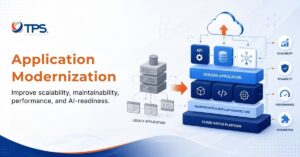
Modernizing software should not start with a new framework, a cloud provider, or a decision to rebuild everything. Instead, an effective application modernization strategy starts with the business. It defines what needs to change, why the change matters, and which systems should receive attention first. Then, it connects those priorities with architecture, data, integrations, security, delivery processes, and future technology needs.
This planning matters because not every application needs the same level of change. For example, one system may only need targeted refactoring. Another may require a new architecture, stronger APIs, or a complete rebuild. At the same time, systems that still work well today may need changes to support future AI capabilities.
Therefore, the goal is not simply to replace old technology. A good modernization strategy creates a practical path from the current state to a software foundation that can support business growth, faster delivery, and new capabilities such as AI.
What Is an Application Modernization Strategy?
An application modernization strategy is a structured plan for improving existing software while balancing business value, technical risk, cost, and future requirements.
It helps an organization answer several important questions. Which systems create the most business value? Where does technical debt create the greatest risk? Which applications can stay as they are? More importantly, which ones need refactoring, re-architecture, migration, or rebuilding?
As a result, modernization becomes a business and engineering decision rather than a simple technology upgrade.
A complete strategy usually considers the current codebase, architecture, dependencies, data, APIs, infrastructure, testing, security, documentation, and delivery processes. In addition, organizations should consider where the software needs to go next. For many businesses, that now includes cloud adoption, greater automation, better data accessibility, and AI readiness.
Microsoft takes a similar strategy-first approach to modernization. Its guidance begins with defining business goals, assessing applications, prioritizing workloads, choosing the right modernization path, and then implementing changes in phases.

Why Modernization Strategy Should Come Before Technology
A common mistake is to decide on the technology first.
For example, a team may decide to move to microservices because the current system uses a monolithic architecture. Another organization may migrate an application to the cloud and assume the modernization work is complete. However, neither decision guarantees a better system.
A new architecture only creates value when it solves a real business or engineering problem. Likewise, moving an application to the cloud does not automatically remove technical debt, improve maintainability, or simplify integrations.
Instead, the strategy should begin with desired outcomes. The organization may need to release features faster, reduce maintenance effort, support more users, improve system reliability, or integrate new business systems. Increasingly, it may also need to prepare its core software for AI.
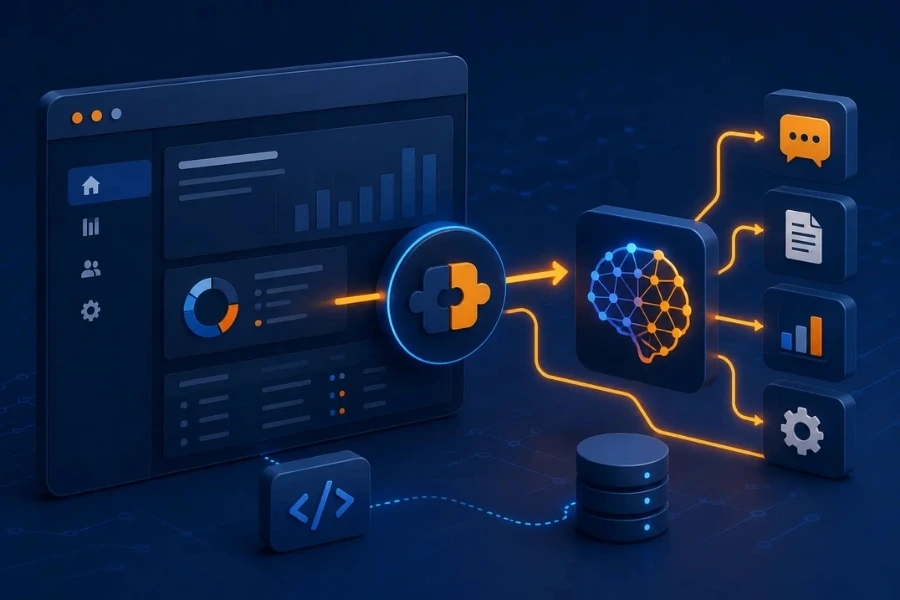
That last requirement can change modernization priorities significantly. AI agents, intelligent search, employee copilots, predictive analytics, and workflow automation all depend on more than an AI model. They also need accessible data, reliable APIs, clear system boundaries, secure permissions, and stable business processes.
Therefore, organizations should ask not only:
“How do we modernize this system?”
They should also ask:
“What must this system be able to support over the next three to five years?”
TPS applies this broader view to modernization. Its current service covers architecture, data migration, APIs, cloud-native foundations, CI/CD, security, and AI-ready capabilities rather than treating modernization as a code rewrite alone.
See it in practice: In one TPS modernization project, a revamped architecture helped increase system performance by 200%, while CI/CD improvements reduced deployment time by 75%. Read the Legacy System Modernization case study
How to Build an Application Modernization Strategy
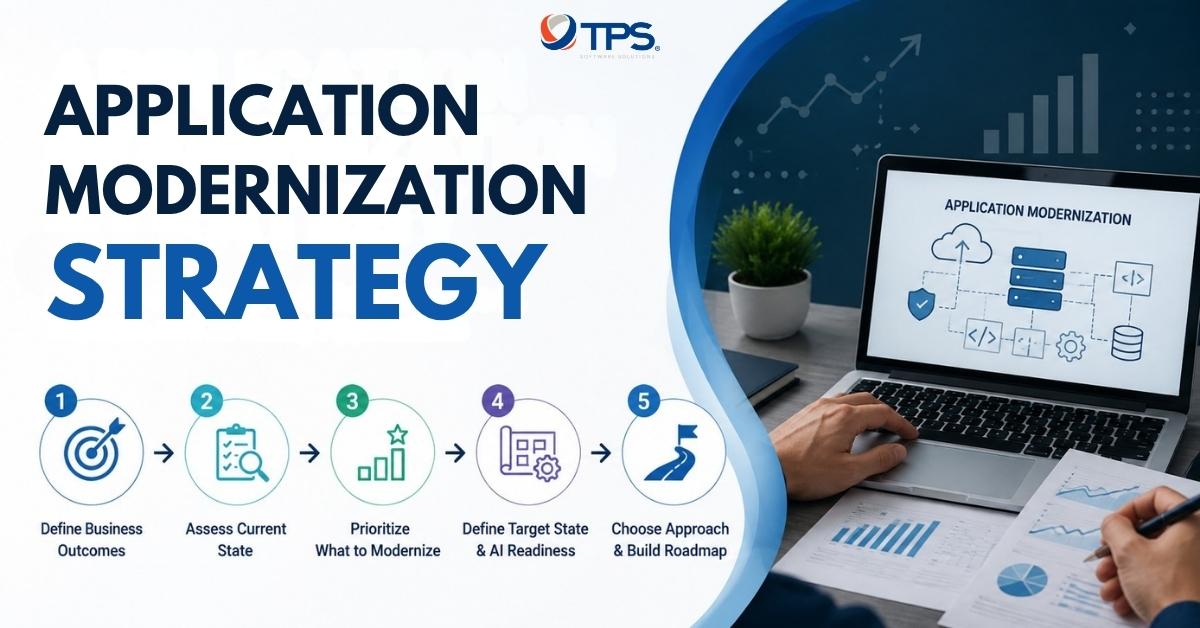
A strong application modernization strategy connects business goals with technical decisions. Therefore, the process should not begin with a cloud platform, a framework, or an architecture pattern. Instead, it should start with the outcomes the business wants to achieve and then define the changes needed to support them.
The following five steps provide a practical way to move from assessment to execution.
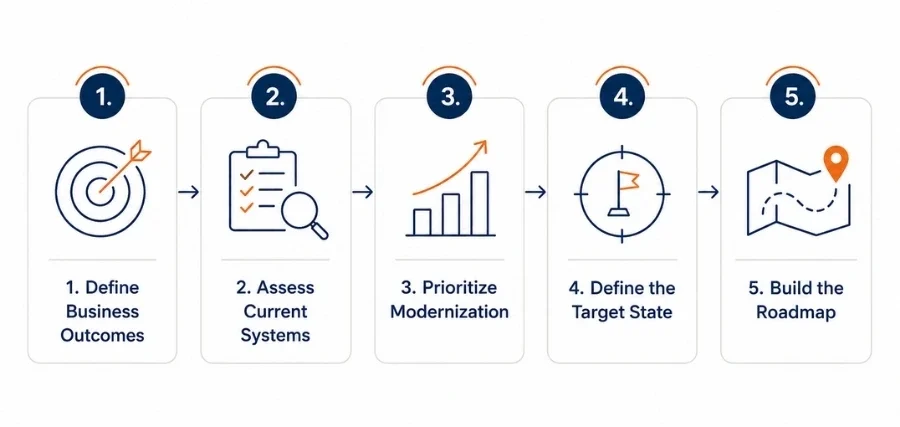
Step 1. Define the Business Outcomes First
First, clarify what the modernization effort needs to achieve.
For some organizations, the main goal may be faster feature delivery. Others may need to reduce maintenance costs, improve performance, strengthen security, support more users, or connect systems more easily. In addition, companies preparing for AI may need better access to data, stronger APIs, and more flexible architecture.
These goals should guide the technical decisions that follow. For example, a company that wants faster releases may focus on reducing tight dependencies and improving CI/CD. In contrast, a company planning AI use cases may place greater emphasis on data accessibility, system integration, and documentation.
Whenever possible, teams should also make the goals measurable. Rather than aiming to “improve delivery speed,” they can target shorter release cycles, fewer deployment failures, or less engineering time spent on maintenance.
As a result, modernization becomes easier to evaluate because success depends on business outcomes, not simply on how much technology the organization replaces.
Step 2. Assess the Current System and Its Dependencies
Next, build a clear picture of the current environment.
A modernization assessment should look beyond the age of the technology. A relatively new application can still become difficult to scale, integrate, or maintain if its architecture no longer supports business needs.
The assessment should examine the codebase, architecture, technology stack, databases, APIs, integrations, infrastructure, testing, deployment processes, security, documentation, and technical debt. At the same time, teams need to understand how important each system is to the business.
This business context matters because technical condition alone does not determine modernization priority. For example, an outdated internal tool may have little impact on daily operations. Meanwhile, a customer-facing platform may require urgent changes even if its technology is newer.
Dependencies also need close attention. A change to one application can affect ERP, CRM, payment systems, reporting tools, or external partners. Therefore, mapping those relationships early can reduce unexpected problems later in the project.
Step 3. Prioritize What to Modernize
After the assessment, the next step is to decide where modernization will create the most value.
Organizations should avoid modernizing applications simply because they are old. Instead, priority should reflect a combination of business value, technical risk, modernization effort, and future importance.
A simple matrix can help teams compare systems more clearly:
| System | Business Value | Technical Risk | Future Importance | Priority |
|---|---|---|---|---|
| Core order platform | High | High | High | High |
| Customer portal | High | Medium | High | High |
| Internal reporting tool | Medium | Low | Medium | Medium |
| Low-use utility | Low | High | Low | Low / Consider retirement |
This approach helps teams focus resources where business importance and technical constraints meet.
For example, a system that supports revenue, customer experience, or critical operations may deserve early attention if technical debt slows every change. In contrast, a low-value application with high modernization costs may be a better candidate for retirement or replacement.
Therefore, the goal is not to modernize everything. The goal is to modernize the right systems in the right order.
Step 4. Define the Target State — Including AI Readiness
Once priorities are clear, define what each modernized system should become.
The target state should describe more than a new technology stack. It should explain how the application needs to operate, integrate, scale, and support future business requirements.
In practice, this may include clearer service boundaries, more reliable APIs, better access to business data, stronger security controls, automated deployment, improved observability, and better documentation.
For organizations planning future AI initiatives, this step becomes even more important. AI capabilities rarely work well when data remains fragmented, APIs are limited, or business processes are difficult to access.
Therefore, AI readiness should become part of the architecture discussion from the beginning rather than an add-on after modernization.
A stronger foundation can make it easier to introduce AI agents, intelligent search, employee copilots, predictive analytics, document intelligence, and workflow automation. However, not every system needs every capability. The strategy should identify which applications may support future AI use cases and what technical foundation they need first.
Step 5. Choose the Right Approach and Build a Phased Roadmap
Finally, choose the modernization approach based on the business goals, current-state assessment, and target architecture.
Some applications may only need targeted refactoring. Others may require replatforming, re-architecture, rebuilding, or replacement. Because each system has different constraints, organizations should avoid applying one modernization approach across the entire portfolio.
Once the approach is clear, turn the strategy into a phased roadmap. The first phase may focus on discovery and assessment, while the next addresses architecture, APIs, data, security, or delivery foundations. After that, a pilot can validate the approach before the organization expands the work to more critical systems.
This phased model also gives teams room to learn. For example, an early pilot may reveal undocumented business logic, unexpected dependencies, or integration constraints. Teams can then update the roadmap before those issues affect a larger part of the modernization program.
Therefore, modernization does not need to become a single high-risk replacement project. A well-designed strategy can break the work into manageable stages while still moving the organization toward a clear target state.

Common Mistakes That Weaken an Application Modernization Strategy
Even a strong modernization plan can fail if teams focus too much on technology and not enough on business needs, dependencies, and execution risk.
- Modernizing everything at once: Large-scale changes can increase delivery risk and make testing harder. Instead, teams should prioritize critical systems and modernize in manageable phases.
- Choosing technology before defining the problem: A newer architecture does not always create better results. For example, microservices may improve scalability, but they also add complexity. Therefore, technology choices should solve a clear business or technical need.
- Ignoring dependencies and business logic: Applications often connect with ERP systems, databases, third-party services, and internal tools. Important business rules may also exist only in the code or in team knowledge, so teams should map these dependencies early.
- Treating cloud migration as modernization: Moving an application to the cloud may improve infrastructure, but it does not automatically fix technical debt, weak architecture, or difficult integrations. In many cases, deeper changes are still required.
- Measuring completion instead of business impact: A modernization project should improve outcomes such as delivery speed, reliability, scalability, and maintenance effort. In addition, the new foundation should support future capabilities such as automation and AI.
Application Modernization Strategy Checklist
Before implementation, teams should confirm that the strategy covers:
- Business outcomes: What should modernization improve?
- Priorities: Which systems or components should change first?
- Current risks: What technical debt, dependencies, or knowledge gaps exist?
- Target state: What should the modernized system look like?
- Modernization approach: Should the system be refactored, replatformed, re-architected, rebuilt, or replaced?
- Success metrics: How will the organization measure the results?
If several of these areas remain unclear, the organization may need further assessment before major technical work begins.
Turn Your Strategy Into a Practical Modernization Roadmap
An application modernization strategy only creates value when teams can turn it into clear actions.
Therefore, the roadmap should connect business priorities with technical work. It should show what to modernize first, which approach to use, and how each phase supports the target state. Just as importantly, the plan should leave room for new requirements as the business grows.
For many organizations, that target state now includes AI readiness. However, adding AI later can become difficult if data remains fragmented, APIs are limited, or core systems are hard to change. Modernization gives teams a chance to address these foundations before AI initiatives depend on them.
TPS approaches modernization from both the business and engineering sides. The process starts with the existing code, architecture, workflows, and technical debt. From there, TPS helps rebuild the foundation through modern architecture, data migration, deployment, security, and AI-ready capabilities.
Planning a modernization project? Explore TPS Application Modernization Services to see how TPS helps businesses move from existing systems to scalable, AI-ready platforms.
FAQs
1. What should an application modernization strategy include?
An application modernization strategy should connect business goals with the current technical state and the desired future state. It normally covers system assessment, priorities, architecture, data, integrations, security, modernization approaches, implementation phases, and success metrics.
2. How do you prioritize applications for modernization?
Start with business value, technical risk, modernization effort, and future importance. A system may deserve higher priority when it supports critical operations but technical limitations slow growth, integrations, or new product development.
3. Does application modernization always require a full rebuild?
No. Depending on the system, teams may refactor, replatform, re-architect, rebuild, replace, or retain parts of the existing application. The right choice depends on the business goal and the condition of the current system.
For a detailed comparison of these approaches, read Application Modernization: Benefits, Approaches & Process.
4. How does AI readiness affect an application modernization strategy?
AI readiness adds new requirements to the target state. For example, applications may need better data access, reliable APIs, clearer system boundaries, stronger permissions, and more scalable infrastructure.
As a result, organizations can prepare the core system before introducing AI agents, intelligent search, copilots, predictive analytics, or workflow automation.
TPS Software