Every e-commerce business monitors competitor prices. The question isn’t whether you do it — it’s how fast, how accurately, and how much the gap between your data and the market is actually costing you.
For most teams, the honest answer is: slower than they think, less accurately than they assume, and more expensive than they’ve ever calculated.
What Reactive Pricing Actually Looks Like
Here’s the process that 80% of e-commerce teams run today:
Someone opens 10–20 competitor product pages on Monday morning. Copies prices into a spreadsheet. Compares to internal pricing. Flags anything that looks off. Sends a report by end of day — if they have time. The pricing team reviews on Tuesday or Wednesday. Changes are pushed by Thursday or Friday.
Total cycle time: 3–5 business days from market movement to price adjustment.
In that window, three things are happening:
You’re Losing Sales You Don’t Know About
A competitor dropped their price on Monday. Your product is now 15% more expensive. Shoppers comparison-shop. They buy from the competitor. You don’t see lost conversions in your analytics — they show up as traffic that didn’t convert, not as sales lost to price.
You’re Leaving Margin on the Table You Can’t See
A competitor raised their price or went out of stock on Wednesday. You could have raised your price by 5–8% with no impact on volume. But you won’t know until next Monday’s report. Five days of extra margin, gone.
You’re Guessing Which Products Are Price-Sensitive
Without continuous data, you can’t distinguish products where price drives the purchase decision from products where brand, availability, or features matter more. So you apply the same pricing logic to everything.

The Math Nobody Does
Take a mid-sized e-commerce operation with 5,000 active SKUs and $5M in annual revenue.
Most teams never calculate this because the losses are invisible.
What Changes When Monitoring Runs Continuously
The fundamental difference between reactive pricing and competitive pricing intelligence isn’t sophistication — it’s speed.
Continuous Collection
Instead of weekly manual checks, AI collects competitor pricing data automatically — across platforms, across categories, continuously. Your pricing data reflects the market right now, not the market last Monday.
Intelligent Product Matching
Manual monitoring compares products by name or SKU — which misses variants, bundles, rebrands, and private-label equivalents. AI matching uses semantic similarity: it understands that two differently named products on different platforms are the same product. This catches competitive pressure that manual monitoring systematically misses.
Automated Gap Analysis
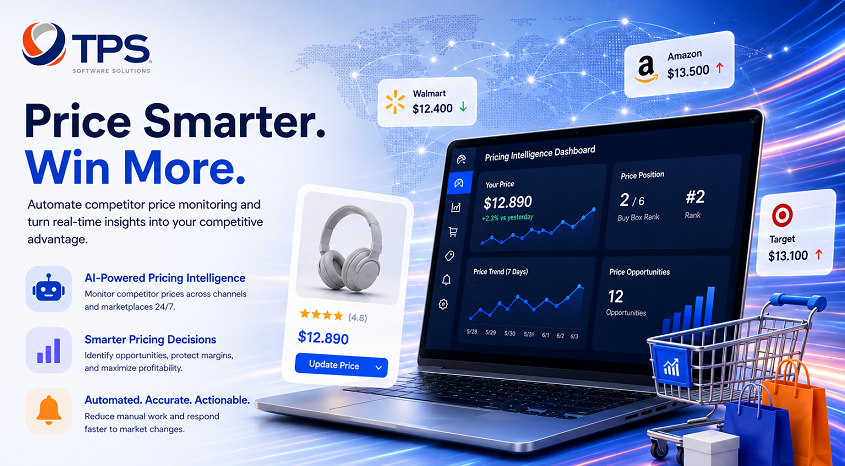
Instead of a spreadsheet that tells you “competitor X charges $Y,” the system tells you which products are overpriced, which have room for increase, which are most price-sensitive, and which competitors are repricing most aggressively.
Actionable Output, Not Raw Data
The pricing team receives recommendations, not research. “These 47 SKUs are priced 10%+ above market average — estimated revenue impact: $X/month” is actionable. A spreadsheet with 5,000 rows of competitor prices is not.

Response Time as Competitive Advantage
One of our customers repriced 4,000 SKUs within 2 hours of a major competitor’s flash sale. Their previous process: they wouldn’t have known the sale was happening until the next Monday. By then, the competitor’s sale was over — and so were the lost sales.
In fast-moving categories — electronics, FMCG, fashion, seasonal goods — competitor pricing changes daily. Sometimes hourly during promotional periods. A 3–5 day monitoring cycle means you’re structurally behind the market at all times.
Reducing response time from days to hours changes your competitive position: from reactive (adjusting after the market has moved) to responsive (adjusting as the market moves) to strategic (anticipating where the market is going based on trend data).
Who Benefits Most
Competitive pricing intelligence has the highest impact for businesses where:
- Price is a primary purchase driver — commodity categories, multi-brand retailers, marketplaces where shoppers comparison-shop actively
- Catalog size makes manual monitoring impractical — at 5,000+ SKUs, you’re only checking a sample, missing most market movement
- Competitor landscape is dynamic — many sellers, frequent promotions, seasonal pricing fluctuations
- Margin pressure is real — when the difference between pricing correctly and pricing 5% off is the difference between profitability and loss
What to Measure When Evaluating Pricing Intelligence
Track these four numbers for one month:
- How many of your SKUs are currently overpriced vs. market?
You probably don’t know. That’s the point. A pricing intelligence tool will tell you on day one. - How many SKUs have room for a price increase?
Equally invisible without continuous data. This is the margin opportunity hiding in your catalog. - What is your current price-check cycle time?
From market movement to price adjustment in your storefront. If it’s more than 24 hours, you’re structurally behind. - How many hours per week does your team spend on manual competitor monitoring?
This is the labor cost you can redeploy to strategic pricing work — category strategy, promotional planning, margin optimization.
Conclusion
Reactive pricing isn’t a strategy. It’s a default — one that most teams have never calculated the cost of because the losses are invisible.
The businesses that price competitively in 2026 don’t have better intuition about pricing. They have better data — collected continuously, matched intelligently, analyzed automatically, and delivered as actionable recommendations rather than raw spreadsheets.
The pricing gap between your data and the market is costing you more than you think. The good news: it’s fixable — and the ROI is measurable from month one.
Want to see where your catalog sits relative to competitors?
Book a 30-minute demo — we’ll run a competitive pricing scan on your actual catalog.
Book a 30-Minute Session →