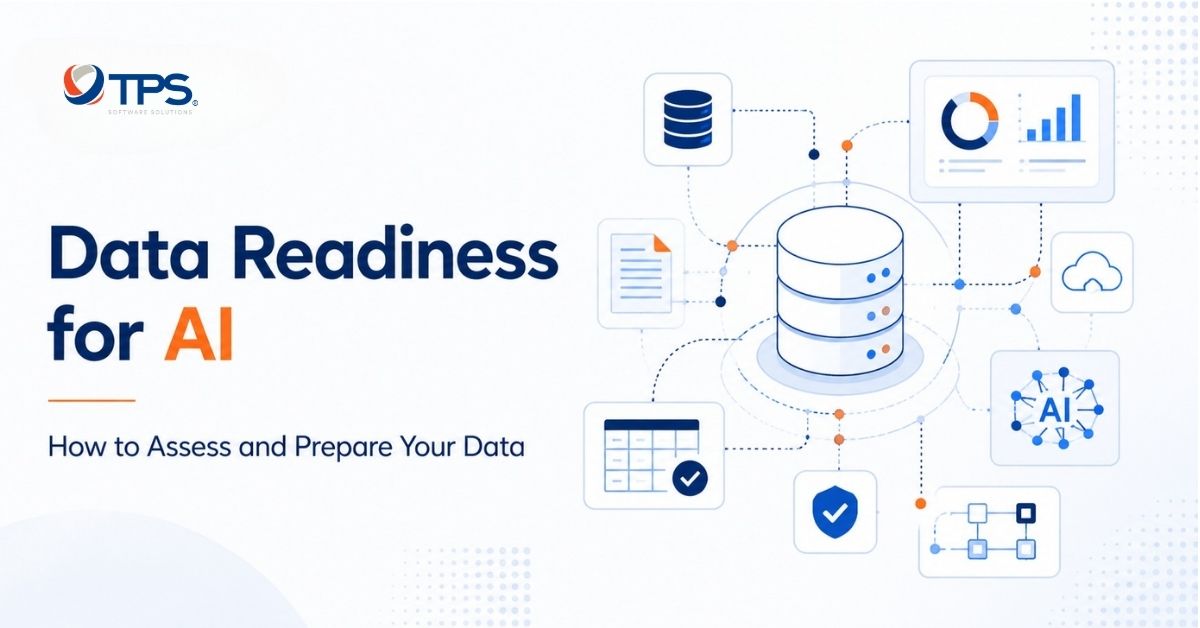
Data readiness for AI determines whether an organization’s data can reliably support AI models, applications, and automated decision-making. Many AI initiatives struggle not because of the model itself, but because the underlying data is fragmented, inconsistent, difficult to access, poorly governed, or missing the context AI systems need.
Preparing data for AI does not mean cleaning every dataset across the organization. Instead, businesses need to understand what data a specific AI use case requires, assess whether that data is usable and trustworthy, and address the gaps that could limit performance, security, or scalability.
This guide explains what makes data AI-ready, how to assess AI data readiness, and how organizations can build a stronger data foundation for AI.
What Is Data Readiness for AI?
Data readiness for AI refers to how well an organization’s data can support a specific AI use case. AI-ready data should be accurate enough, accessible, relevant, secure, and supported by the right context, governance, and traceability.
However, data does not need to be perfect before an AI initiative can begin. Different AI applications require different types of data and different levels of quality. For example, a predictive model may depend on consistent historical records, while a generative AI application may rely more heavily on documents, product information, emails, or other unstructured data with clear metadata and permissions.
For this reason, organizations should assess AI data readiness in the context of the intended use case rather than applying the same standard across every dataset.
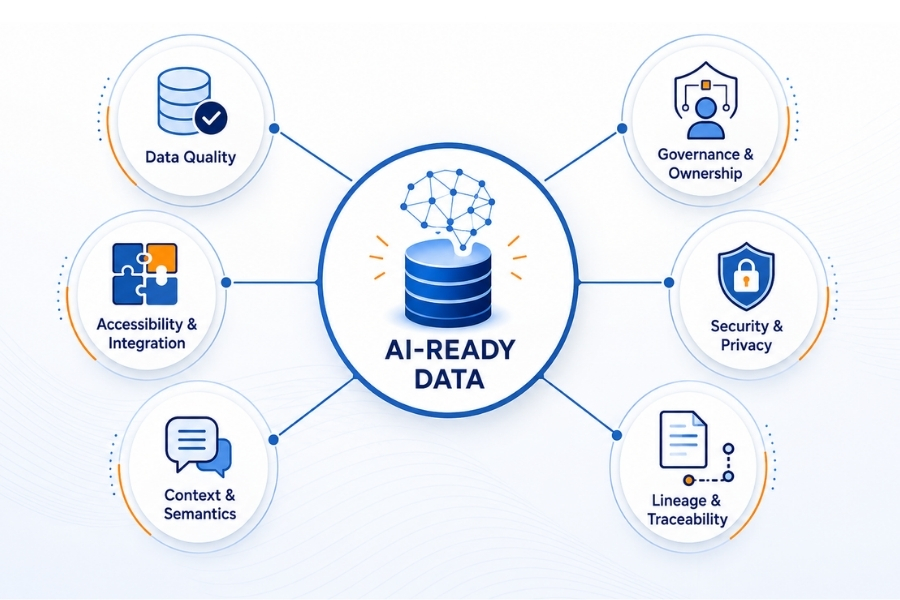
In practice, a strong data foundation for AI combines data quality, accessibility, integration, governance, security, context, and lineage. Together, these elements help AI systems access the right information, interpret it correctly, and produce more reliable outputs.

Related read: Learn how application modernization can improve architecture, scalability, integration, and AI readiness.
Why Data Becomes a Bottleneck for AI
AI systems depend on reliable, accessible, and well-contextualized data. When the underlying data environment is weak, even a strong AI model can become difficult to trust, deploy, or scale.
Common data bottlenecks include:
- Fragmented data: Important information may sit across disconnected applications, databases, spreadsheets, and third-party systems, making it difficult for AI to access a complete view.
- Poor data quality: Incomplete, outdated, duplicated, or inconsistent data can reduce model accuracy and lead to unreliable outputs.
- Inconsistent formats and definitions: Different systems may store the same information in different ways or use different definitions for the same business metric.
- Missing context and metadata: AI systems need more than raw data. Without clear labels, metadata, relationships, and business context, the information can be difficult to interpret correctly.
- Limited access and weak governance: Unclear ownership, restrictive access, or inconsistent permissions can prevent AI systems from using the data they need while also creating security and compliance risks.
- Unstructured data challenges: Documents, emails, PDFs, images, and other unstructured sources can be valuable for AI, but they often require better organization, metadata, and retrieval mechanisms before they become usable.
- Unreliable data pipelines: If data pipelines are slow, unstable, or difficult to monitor, AI applications may receive stale or inconsistent information.
These issues affect more than model performance. They can increase integration effort, delay deployment, raise governance risks, and make AI systems harder to scale across the business.
What Makes Data Ready for AI?
Data becomes ready for AI when it can support a specific use case reliably, consistently, and at the level of quality the application actually requires. That means looking beyond whether data simply exists. Organizations also need to consider whether AI systems can access it, understand its meaning, trust its source, and use it without creating unnecessary security or governance risks.
A strong data foundation for AI usually depends on several connected factors. If one of them is weak, the AI system may still work in a pilot, but it can become much harder to operate, scale, or trust in production.
Data Quality
The first requirement is data quality. AI models rely on patterns in the information they receive, so incomplete, outdated, duplicated, or inconsistent data can directly affect the quality of the output.
However, data quality for AI should not be treated as a universal standard. The right level of accuracy, completeness, and freshness depends on the use case. A forecasting model may require years of consistent historical data, while an AI assistant that answers questions about internal policies may depend more on current documents and accurate metadata.
This is why organizations should evaluate whether the data is fit for purpose, rather than trying to clean every dataset to the same standard.
Accessibility and Integration
Good data has limited value if the AI system cannot access it when needed. In many organizations, useful information is spread across ERP systems, CRM platforms, databases, cloud applications, spreadsheets, document repositories, and third-party services.
Building AI-ready data therefore often requires stronger integration between these sources. APIs, data pipelines, connectors, and shared data platforms can help bring information together and make it available to AI applications in a more consistent way.
Accessibility also needs to be controlled. The objective is not to give AI unrestricted access to everything, but to ensure that it can retrieve the right information from the right source under the right permissions.
Context and Semantics
AI systems do not only need data; they also need enough context to interpret that data correctly.
For example, two systems may use the same term but define it differently, or they may store the same customer, product, or transaction under different identifiers. Without clear definitions and relationships, an AI system can retrieve technically correct data but still misunderstand what that data means in the business context.
Metadata, consistent naming conventions, common business definitions, and semantic models can help reduce this ambiguity. This becomes especially important for generative AI and AI agents, which often need to combine information from several sources before producing a response or taking an action.
Governance and Ownership
As AI uses more enterprise data, questions about ownership and responsibility become more important.
Organizations need to know who owns each critical dataset, who is responsible for its quality, who can access it, and how teams may use it. Without clear ownership, data issues can remain unresolved because no one is accountable for fixing or maintaining them.
Strong data governance for AI also helps organizations establish common standards for data usage, retention, access, and quality. This becomes increasingly important as AI moves beyond individual experiments and starts supporting business processes across multiple teams.
Security and Privacy
Data readiness also means ensuring that AI systems use enterprise information safely.
Many AI applications work with customer records, employee information, financial data, internal documents, intellectual property, or other sensitive content. Organizations therefore need appropriate access controls, authentication, permissions, masking, and privacy safeguards before connecting these sources to AI systems.
Security should be designed into the AI data foundation from the beginning rather than added after deployment. A useful AI application should not create a situation where users can access information they would not normally be authorized to see.
Lineage and Traceability
Organizations also need visibility into where data comes from and how it changes before an AI system uses it.
Data lineage helps teams trace information back to its original source, understand transformations that occurred along the way, and identify which datasets contributed to a particular output. This is valuable when teams need to investigate an incorrect result, validate a decision, or determine whether a source has become outdated.
Traceability becomes especially important as AI applications combine information from multiple databases, documents, APIs, and external systems. Without it, teams may struggle to explain why an AI system produced a particular result or determine where a problem originated.
Together, data quality, accessibility, context, governance, security, and lineage form the core of data readiness for AI. Organizations do not need every dataset to reach the same standard, but the data supporting each AI use case needs to be reliable enough for the decisions, recommendations, or actions the system is expected to make.
How to Assess Data Readiness for AI
A data readiness assessment for AI should begin with the business use case, not with a broad effort to clean every dataset. Different AI applications depend on different data sources, quality standards, and governance requirements. Therefore, organizations need to evaluate whether the data can support the specific outcome they expect from AI.
Start with the AI use case
First, define what the AI application needs to do. For example, an organization may want to forecast demand, automate document processing, build an internal AI assistant, or support customer service with generative AI.
The use case determines what data the system needs, how current that data must be, and what level of accuracy the business can accept. It also helps teams avoid spending time improving datasets that have little impact on the AI initiative.
At this stage, organizations should also define the expected output and how they will measure success. Clear goals make it easier to judge whether the available data is sufficient.
Identify the required data
Next, identify the data sources that the AI system needs to produce useful results.
Relevant information may exist in databases, business applications, APIs, spreadsheets, cloud storage, documents, emails, images, or external platforms. Teams should understand where each source lives, who owns it, how frequently it changes, and how the AI application can access it.
This inventory should include both structured and unstructured data. Generative AI applications, in particular, often depend heavily on documents and other content that traditional analytics projects may not treat as primary data sources.
Evaluate data quality and usability
Once teams identify the required data, they can assess whether it is fit for the intended purpose.
They should look for missing values, duplicate records, conflicting definitions, outdated information, inconsistent formats, and gaps in coverage. However, the goal is not to achieve perfect data quality. Instead, teams need to determine whether these issues could materially affect the AI system’s output.
For example, a small amount of missing historical data may have little impact on one use case. In another case, outdated product or policy information could cause a generative AI assistant to provide incorrect answers.
Review governance, security, and lineage
Data may have sufficient quality but still remain unsuitable for AI if teams cannot use it safely or trace its origin.
Organizations should confirm who owns each critical dataset, which users and applications can access it, and whether privacy or regulatory requirements restrict its use. They should also understand how data moves between systems and what transformations occur before the AI application receives it.
This step becomes especially important when AI combines information from several enterprise systems. Strong governance and data lineage help teams investigate problems, control sensitive information, and maintain confidence in AI-generated results.
For organizations that need broader support assessing their technology, architecture, and data environment, TPS’s Software & IT Consulting services include technology assessment and data management and analytics capabilities.
Identify gaps and prioritize improvements
Finally, compare the current data environment with the requirements of the AI use case. This comparison reveals the gaps that could prevent successful implementation or limit future scalability.
For instance, one project may need better data integration before development begins. Another may require stronger metadata, access controls, or data cleaning. In some cases, teams may need to address several issues together.
Rather than fixing every weakness across the entire data estate, organizations should prioritize the gaps that create the greatest risk or directly block the use case. This approach makes AI data readiness more practical and allows teams to improve the data foundation as AI adoption expands.
How to Improve Data Readiness for AI
Once organizations identify the main gaps, they can improve data readiness for AI by focusing on the data that directly supports priority use cases. The goal is not to redesign the entire data environment at once. Instead, teams should remove the constraints that prevent AI systems from accessing, understanding, and using information reliably.
Unify fragmented data sources
First, teams need to reduce unnecessary data silos. Critical information often sits across CRM systems, ERP platforms, databases, spreadsheets, document repositories, and third-party applications.
Organizations do not always need to move everything into one platform. However, they should create reliable ways for AI applications to access relevant data across these sources. APIs, integration layers, data pipelines, and shared data platforms can help establish a more connected data foundation for AI.
When outdated platforms or disconnected architectures make data difficult to access, broader application modernization services can also help improve the systems and integrations that support AI initiatives.
Clean and standardize critical datasets
Next, organizations should focus data cleaning efforts on the datasets that matter most to the use case.
Teams may need to remove duplicates, resolve conflicting records, standardize formats, correct missing values, or align different definitions of the same business entity. For example, customer or product information may appear differently across several applications. AI systems can struggle to connect those records when identifiers and definitions do not match.
Rather than aiming for perfect data across the organization, teams should establish quality thresholds that match the level of risk and accuracy the AI application requires.
Improve metadata and business context
Data becomes much more useful to AI when it includes enough information to explain what it represents.
Clear metadata, naming conventions, classifications, and business definitions help AI systems interpret information more accurately. This is especially important when organizations use similar terms across different departments or systems.
For generative AI, metadata also improves retrieval. A document becomes more useful when the system understands its topic, owner, creation date, version, permissions, and relationship to other business information.
Strengthen data integration and pipelines
Reliable access also depends on how data moves between systems.
Teams should review whether existing pipelines deliver accurate and current information, especially when an AI application depends on near-real-time data. They may need to improve connectors, APIs, transformation processes, validation rules, or error handling.
If organizations need to consolidate, restructure, or move data as part of this work, TPS’s Application and Data Migration guide covers key considerations such as data mapping, cleansing, validation, migration planning, and testing.
Prepare unstructured data for AI
In addition, organizations need to pay closer attention to unstructured data. Documents, PDFs, emails, images, presentations, and other files often contain valuable business knowledge, particularly for generative AI and retrieval-based applications.
Simply storing these files does not make them AI-ready. Teams may need to extract content, improve metadata, organize documents, remove duplicates, define permissions, and create retrieval mechanisms that help AI systems find the right information.
For example, an enterprise AI assistant needs more than access to thousands of internal documents. It also needs a reliable way to identify which version is current, which users can access it, and which document is relevant to the question.
Establish governance and access controls
At the same time, organizations should define clear rules for how AI applications use enterprise data.
Teams need to establish data ownership, access permissions, retention policies, privacy controls, and usage requirements. These controls become more important as AI applications move from isolated pilots into workflows that interact with customers, employees, or critical business systems.
Strong governance does not only reduce risk. It also makes it easier to scale AI because teams can reuse trusted data sources without reassessing ownership and permissions.
Monitor data readiness continuously
Finally, organizations should monitor the data after AI applications move into production.
Data quality can change over time as source systems, business processes, customer behavior, or data definitions evolve. Pipelines may fail, datasets may become stale, and new data sources may introduce inconsistencies.
Data observability and ongoing validation help teams detect these changes before they significantly affect AI performance. As a result, AI-ready data becomes an ongoing capability rather than the output of a one-time preparation project.
Explore how to build an application modernization strategy that aligns technical priorities with business goals and ready for AI adoption.
How Application Modernization Supports AI Readiness
Improving data readiness often requires more than cleaning or governing data. In many organizations, outdated architecture and fragmented systems create additional barriers. Limited APIs and rigid integrations can also make enterprise data harder for AI applications to access and use.
Application modernization can help remove these constraints. It can improve architecture, data flows, APIs, integrations, cloud infrastructure, and engineering processes. As a result, organizations can build a more connected and scalable foundation for both data and AI.
If system limitations are holding back your AI initiatives, explore TPS’s Application Modernization Services to see how modernization can help prepare your applications and data environment for AI.
FAQs About Data Readiness for AI
1. What does data readiness for AI mean?
Data readiness for AI describes whether an organization’s data can reliably support a specific AI use case. AI-ready data should have sufficient quality, accessibility, context, governance, security, and traceability for the task.
2. How do you know if your data is ready for AI?
Start by evaluating the data required for the intended AI use case. Check whether teams can access the right sources and trust the data quality. They should also understand the business context, control permissions, and trace where the information comes from. A data readiness assessment then helps identify gaps that could affect AI performance or deployment.
3. Does data need to be perfect before starting an AI project?
No. Organizations do not need to clean every dataset before starting an AI initiative. Instead, they should focus on the data that matters to use cases and make sure it meets the required level of accuracy and security.
4. What is the difference between AI readiness and data readiness for AI?
AI readiness covers the broader ability of an organization to adopt AI, including technology, data, skills, governance, processes, and strategy. Data readiness for AI focuses specifically on whether the underlying data can support AI applications reliably and securely.
5. How do you prepare unstructured data for generative AI?
Organizations can prepare unstructured data such as documents, PDFs, emails, and images in several ways. They can improve content quality, remove duplicates, add useful metadata, and define access permissions. They should also build reliable retrieval mechanisms. Clear structure and context help generative AI systems find and use the right information more accurately.