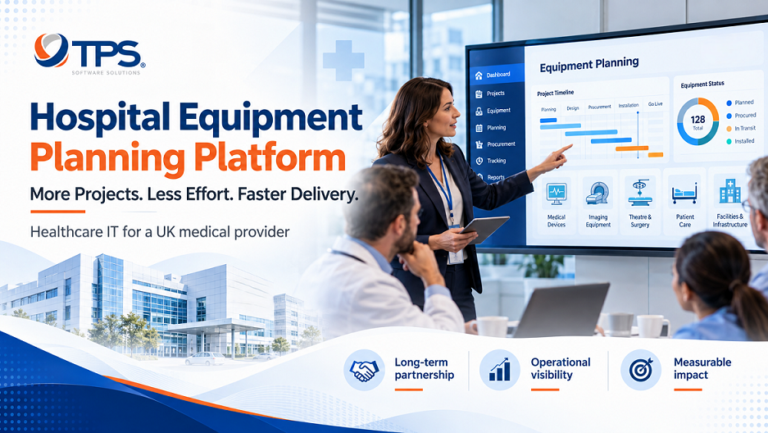
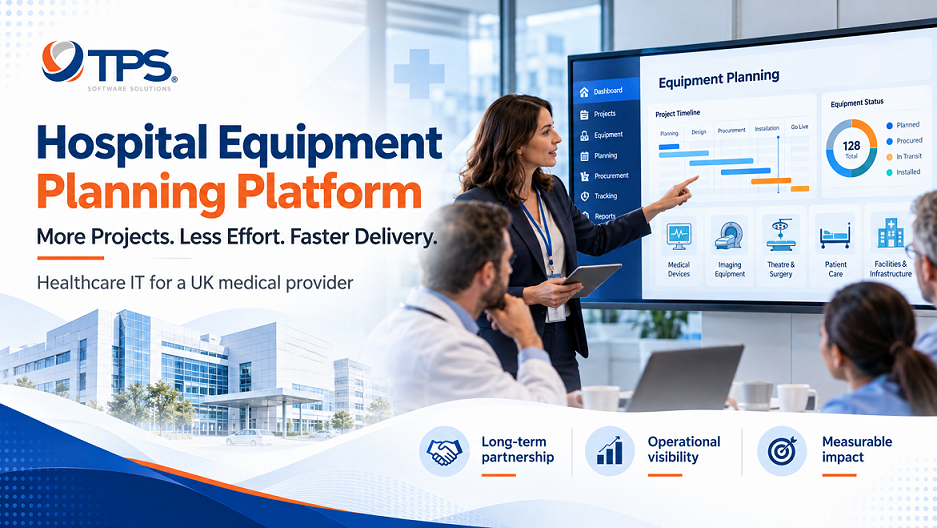
A UK medical provider managing multiple concurrent hospital projects replaced spreadsheets, email threads and manual reporting with a full-cycle hospital equipment planning platform. The same team now handles 30% more projects per year with 30% less planning effort.
About the client
The client is a UK medical provider that plans, specifies and procures equipment for hospital projects, often running several projects at the same time. Hospital construction is a billion-dollar industry, yet much of this planning work was still done by hand.
Challenges
The provider's team had the expertise to manage complex equipment projects. However, manual processes limited how many projects they could take on at once.
Sequential planning
Each project was planned largely in isolation, with limited visibility across concurrent projects and no cross-project procurement leverage.
Slow procurement
Specifications, vendor quotes and approvals lived in email threads and shared drives, so tracking status took time.
Limited visibility
There was no real-time view of project status. Every overview required manually compiled reports.
Capacity constraint
Team capacity was limited by manual overhead, not by expertise. More projects meant more administrative work.
Solution
TPS designed and built a custom full-cycle equipment planning platform that covers the entire project lifecycle in one connected system.
Project lifecycle management
Every project follows standardized stages: planning, specification, procurement, delivery and installation.
Central equipment database
Specifications, vendor options and pricing are stored once and reused across projects, eliminating duplicate specification work.
Procurement workflow
Specification, vendor quote, purchase order and delivery tracking run in one system instead of email threads.
Cross-project visibility
Real-time dashboards show progress, milestones and at-risk items across all concurrent projects.
Delivery tracking
Each equipment item is tracked from purchase order through to installation confirmation.
Before
- Spreadsheets & shared drivesSpecifications recreated for each project
- Email-based procurementQuotes and approvals spread across threads
- Manual status reportsCompiled by hand for every overview
Manual overhead · Capacity limited
After
- Central equipment databaseSpecifications reused across projects
- One procurement workflowSpec → quote → PO → delivery in one system
- Real-time dashboardsStatus across all concurrent projects
+30% projects with -30% planning effort

Results
The platform turned manual overhead into real capacity, allowing the same team to deliver more projects with less effort.
More projects per year
The same team now handles 30% more projects annually.
Less planning effort
Reusable specifications and standardized stages remove duplicate work.
Faster delivery
Equipment moves from planning to installation 25% faster.
Fewer procurement delays
Procurement delays, previously frequent, dropped by 25%.
The most significant result: the same team handles 30% more projects while spending 30% less effort on planning. That is not a linear improvement. It is a capacity multiplier.
What makes this engagement notable
Long-term partnership
An 18-engineer team has worked with the client since 2020, so knowledge of its workflows and priorities keeps compounding.
Non-tech domain, tech solution
The work started with understanding hospital workflows before writing any code.
Measurable operational impact
Results are measured in the client's operational metrics, not in software metrics.

Why it matters for you
Growth does not have to mean more manual work. When expert teams spend their time on coordination, spreadsheets and status reports, capacity depends on hiring. A platform built around how your people actually work can turn that overhead into room for more projects, whether you run hospital programs, construction projects or any operation with many moving parts.
Not sure where to start? Our Software & IT Consulting team can assess your current workflows and systems first.
Start with a 30-minute assessment
Bring your current workflow and the question you are trying to answer. TPS comes back with a written view of options, not a sales deck.
BOOK A 30-MIN ASSESSMENT